You walk out of the hotel into sunshine. Half an hour later it starts to rain. Later the wind picks up and, if you are in the mountains, it can even snow.
If that happened to you, it was not bad luck. And it is not that Ushuaia's weather is unpredictable for no reason: there is a combination of geographical factors that explains why conditions here can change within hours, and sometimes within minutes.
To understand Ushuaia's weather, the first thing to look at is where Ushuaia is.
Ushuaia's climate in numbers
- 🌡️ Warmest month: January, with an average high of 13.6 °C and an average low of 5.4 °C
- ❄️ Coldest month: July, with an average high of 4.6 °C and an average low of 0.2 °C
- 🌧️ Rainfall per year: 457.8 mm, spread over 175 days with precipitation
- 🌨️ Days with snow: 59.5 per year, concentrated between June and August
- ☀️ Sunshine: 1,403 hours per year, an average of 3.9 hours per day
- 💨 Wind: 13 knots on average, about 24 km/h, predominantly from the west and southwest
- 📈 Records: a high of 29.5 °C and a low of -21 °C
There is one fact that surprises almost everyone: in Ushuaia it rains often, but it rains little. With less than 460 mm a year, far less water falls here than in Buenos Aires or Bariloche. What happens is that this rain is spread over many days, almost half the year, and comes as brief drizzle. That is where the feeling that "it is always about to rain" comes from, in a climate that is in fact dry.
In this guide
- Between the ocean and the mountains
- The wind, the main character
- Why does the weather change so fast?
- The weather through the year
- How to read the forecast
- What if the weather changes on the day of your tour?
- What to wear
- Frequently asked questions
Ushuaia sits between the ocean and the mountains
Ushuaia is at 54 degrees south, closer to the South Pole than the vast majority of cities on the planet. But what defines its climate is not so much the latitude as sitting between two enormous things: the ocean on one side and the Andes on the other.
The city sits on the shore of the Beagle Channel, on the Isla Grande de Tierra del Fuego. The water around the island moderates temperatures: it keeps summers from being hot, but it also keeps winters from being as cold as people imagine for the End of the World. That is why in July, the middle of winter, the average temperature is just below 3 °C.
Immediately behind the city, to the north and west, are the Andes. Here the range changes direction: instead of running north to south as it does in the rest of the continent, it lies west to east. That is why Ushuaia has mountains right at its back and water in front.
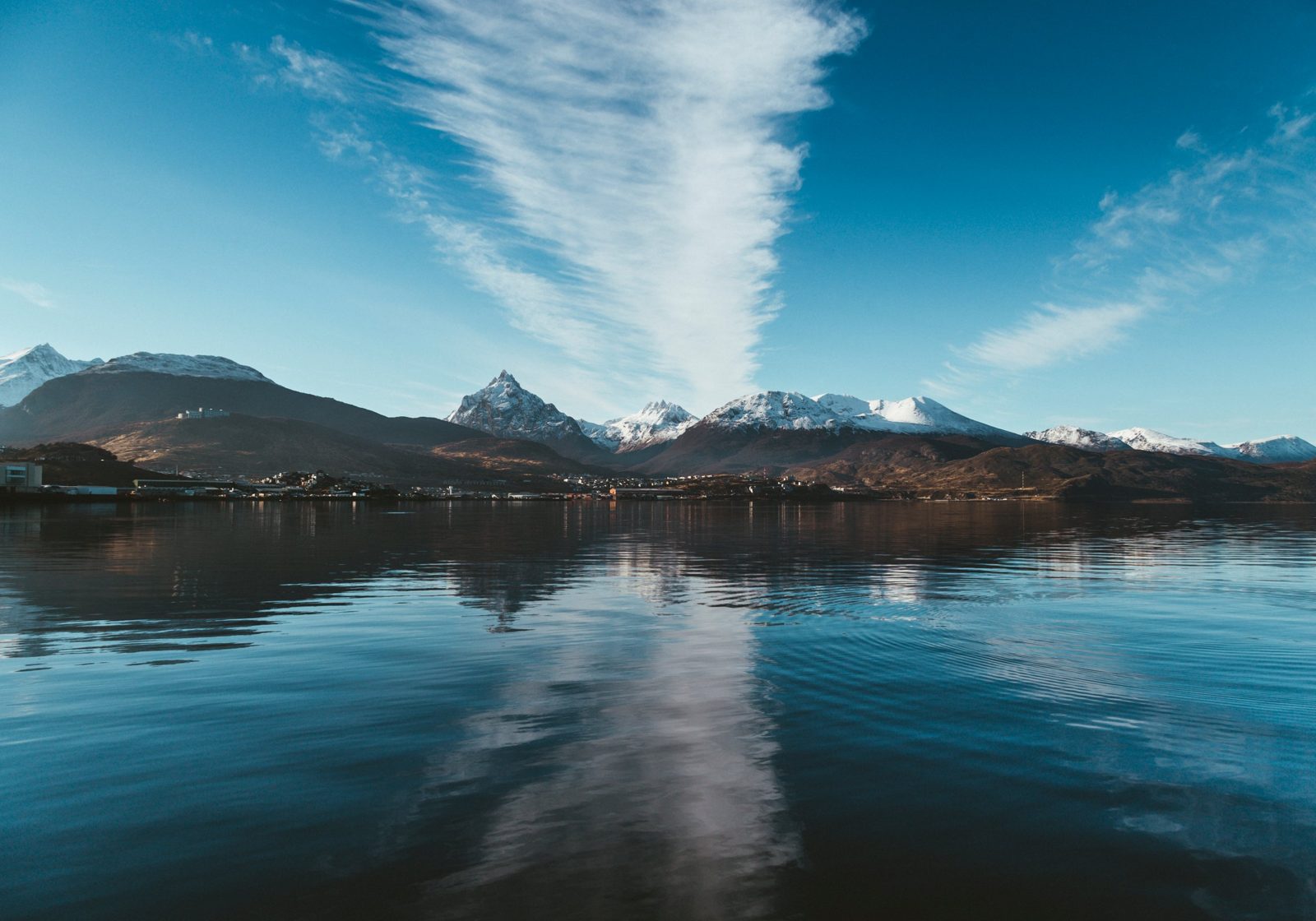
The Andes: a barrier that manufactures weather
The prevailing winds in this part of the planet come from the west, and before reaching Tierra del Fuego they travel thousands of kilometres over the Pacific Ocean. They arrive loaded with moisture.
When those masses of humid air meet the mountain range, they have to rise. And as they rise, they cool. Cold air holds less moisture than mild air, so that moisture condenses: clouds form and precipitation falls. That is why much of the rain and snow falls in the mountains, often while the coast stays clear.
It is the same range you see on the horizon and walk through when you go trekking. The Andes do not only shape Ushuaia's landscape: they also manufacture the weather we get.
The wind, the main character
In Ushuaia the wind blows mainly from the west and southwest, and it is a permanent guest: the annual average is about 13 knots, close to 24 km/h, with recorded gusts of up to 35 knots.
Why does it blow so much, and why more in summer?
Ushuaia lies inside the westerly wind belt, a band that circles the southern hemisphere between 40 and 60 degrees of latitude. There the air moves from west to east almost permanently, pushed by the pressure difference between the high-pressure zones that dominate further north and the low-pressure zones towards Antarctica. The greater that difference, the harder it blows.
On top of that comes something that makes this part of the planet unique: at these latitudes there is almost no land. The wind travels thousands of kilometres of open ocean with no mountains or land to slow it down, and reaches Tierra del Fuego at full strength. It is the same reason why sailors of other centuries spoke with respect of the "roaring forties" and the "furious fifties".
That belt is active all year round, but not with the same intensity: in Ushuaia, the windiest months are the summer ones, which is exactly when most visitors arrive. Autumn and winter tend to bring more calm days.
There is one example of what the wind does here that you will see as soon as you leave the city. Along the shore of the Beagle Channel, or in any exposed area, you will find trees that look combed to one side: the trunk leans and every branch grows in the same direction, like a flag in the wind. They are not twisted or diseased.
They are flag trees, and they are the most visible proof of what the wind does here. On the most exposed sides, new shoots do not prosper: the constant wind and the cold dry them out. The tree ends up growing towards the sheltered side, the only one where it can.
The interesting part is that they work like a compass: they point in the direction the wind is going, which is why almost all of them face the same way. They are the record, built over decades, of a wind that always blows from the same side. Once you spot them, you know where the wind comes from in Ushuaia without looking at the forecast.
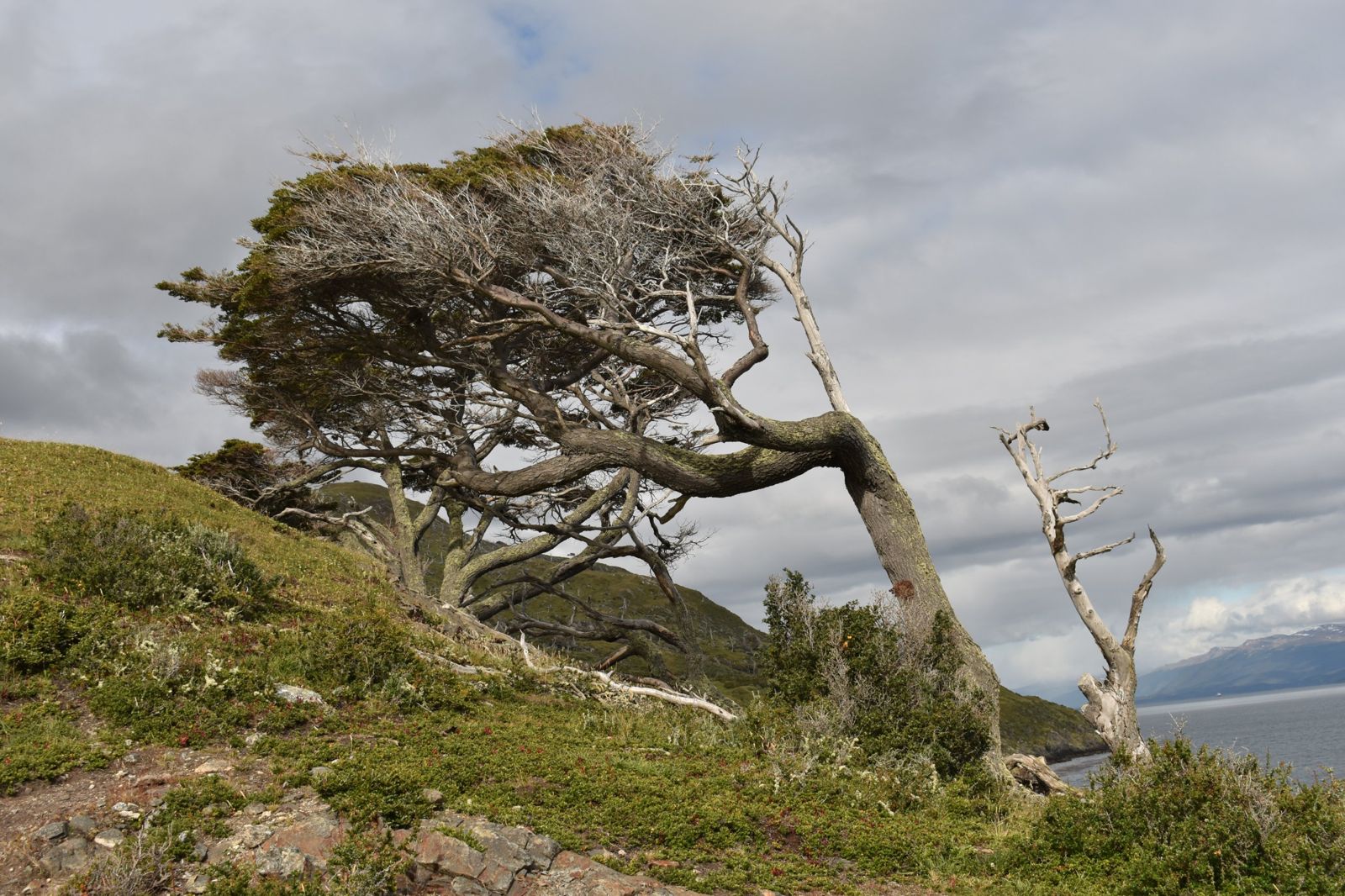
A flag tree on the shore of the Beagle Channel: the branches only grow on the side sheltered from the wind.
The thermometer does not tell the whole story
The wind is what explains the distance between what the thermometer says and what you feel on your body:
- 8 °C with little wind is a pleasant temperature for walking. Once your body is moving, you may even have too many layers on.
- 8 °C with strong wind is something else entirely. Especially if you are standing still, at a viewpoint or on the deck of a boat, and even more so if your clothes are wet.
So when you look at the forecast for Ushuaia, the temperature figure is only half the information. The other half is the wind. It is also the reason why a windproof jacket can keep you warmer than a thick fleece.
Why can the weather change so fast?
There are two reasons, and both are worth understanding.
The first is that Ushuaia sits in a zone crossed by weather systems that move fast, with almost nothing in their way. At these latitudes the air circles the planet over open ocean, with no large landmass to slow it down. When a front arrives, it does not stay: it passes. And another one may follow.
The second is the terrain. In a land of mountains, valleys and coast, conditions are not the same everywhere at the same time. A cloud unloading over one valley can leave the next valley dry. The sunshine in the city is not the sunshine at 600 metres of altitude.
That is why in Ushuaia the weather is measured less in days than in hours.
Is it true that you can get four seasons in one day?
It is the phrase you will hear most about Ushuaia. And the honest answer is: not literally, but that can be the feeling.
In a few hours you can get sun, rain, strong wind and, if you are high up, snow. That is real and happens often, above all in the mountains and in the transition seasons.
What does not happen is the temperature travelling from summer to winter four times in a day. Ushuaia's temperatures are fairly stable: the difference between the warmest and the coldest month is about 7 °C on average, far less than in Buenos Aires or almost any city on the continent. What changes fast is not the thermometer, it is everything else: the sky, the wind, the light and how cold it feels.
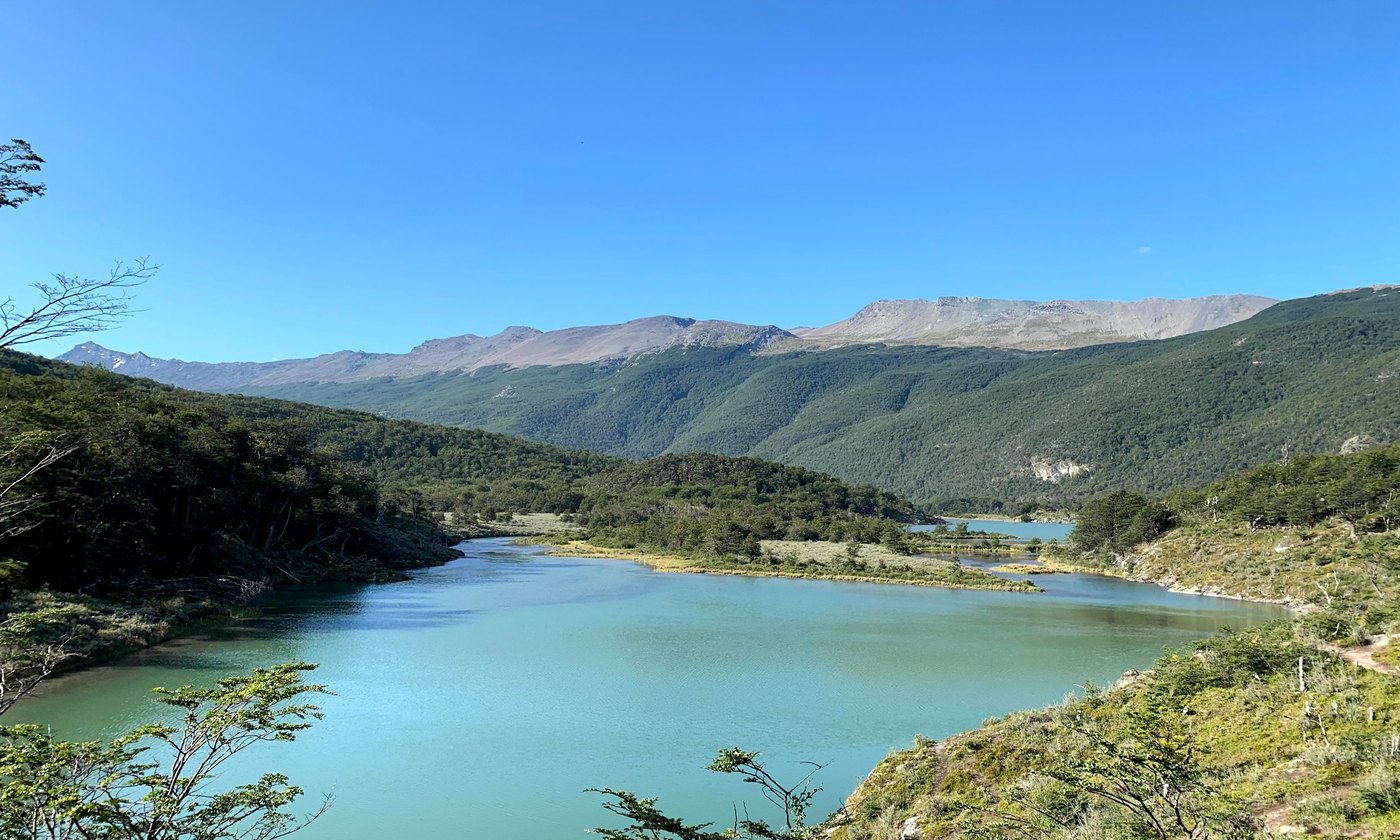
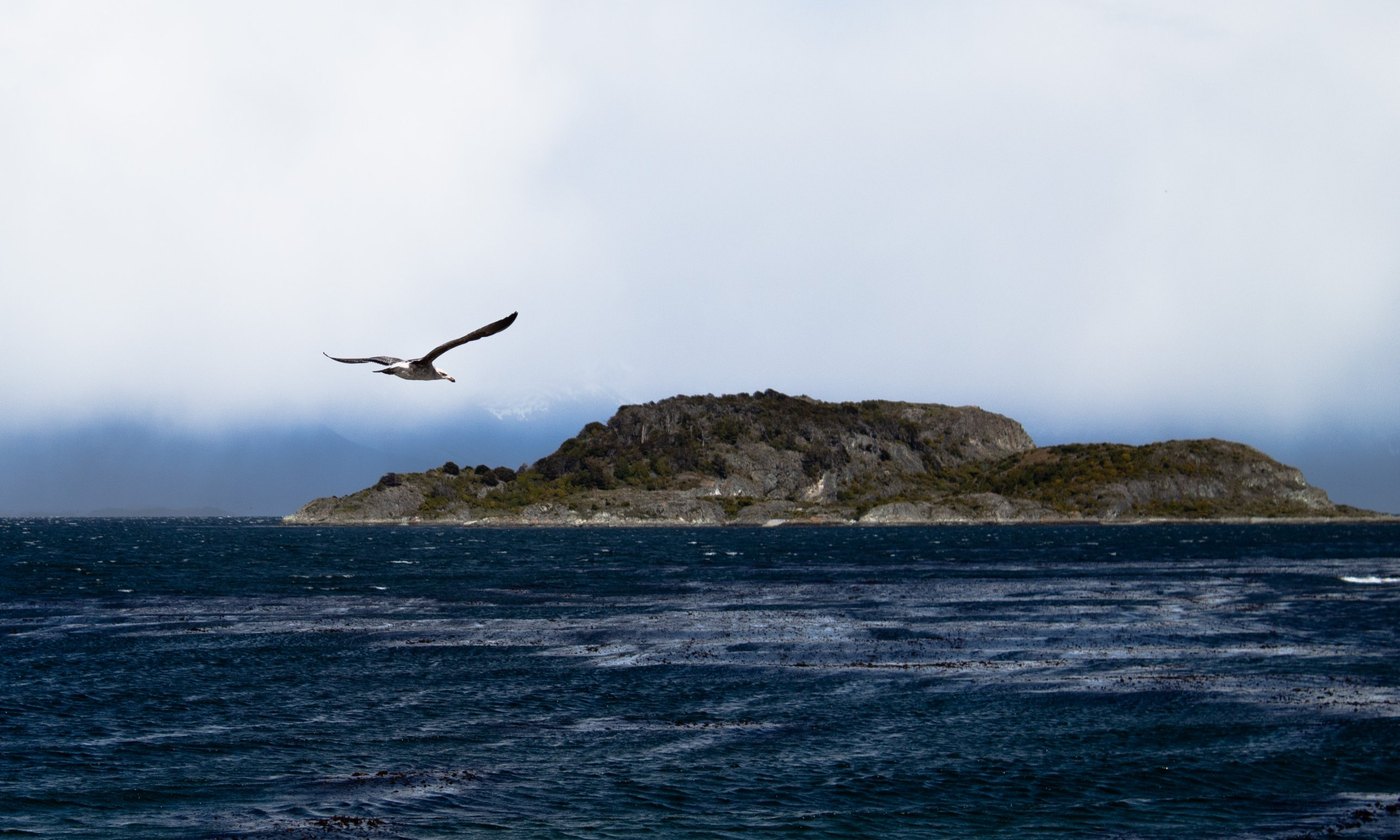
Left: Laguna Verde, clear sky. Right: Isla Redonda from the shore of Bahía Ensenada, with a low cloud over the mountain and wind marked on the water. Two points in the same national park, 15 minutes apart.
The weather in the city is not the weather in the mountains
All the figures above come from the weather station at the airport, at sea level. They describe the city well. They do not necessarily describe the place where you will spend your day:
- Ushuaia and the Beagle Channel coast: this is what the forecast on your phone shows.
- Tierra del Fuego National Park: at sea level, but further west and more exposed to the systems arriving from the Pacific.
- Laguna Esmeralda: in a mountain valley, with conditions of its own. It can be snowing there and not in the city.
- Martial Glacier: a few kilometres from the centre, but considerably higher up. Always colder and windier.
- Higher ground: snow is possible at any time of year.
A simple rule for the traveller: the higher you go, the colder, the windier and the more likely it is to rain or snow than in the city. That is why looking at the Ushuaia forecast is not enough to decide what to take on a mountain hike.
The weather also changes a lot through the year
Summer (December to February). Very long days, with light until past 10 pm. Mild temperatures, with average highs of about 13 °C. It is the windiest time of the year, and also the one with the most changeable conditions.
Autumn (March to May). Temperatures drop gradually, the forest turns yellow and red, and the first snow falls on high ground. May brings the calmest days in terms of wind.
Winter (June to August). This is when it snows: about ten days with snow per month. Temperatures drop, though less than people imagine, with average highs around 5 °C. Few hours of daylight and a completely white landscape.
Spring (September to November). The most variable season of all. Snow on high ground, thaw, sun and wind, often on the same day. November is already starting to get windy.
If you are deciding when to travel, we go into detail in our guide on when to visit Ushuaia.
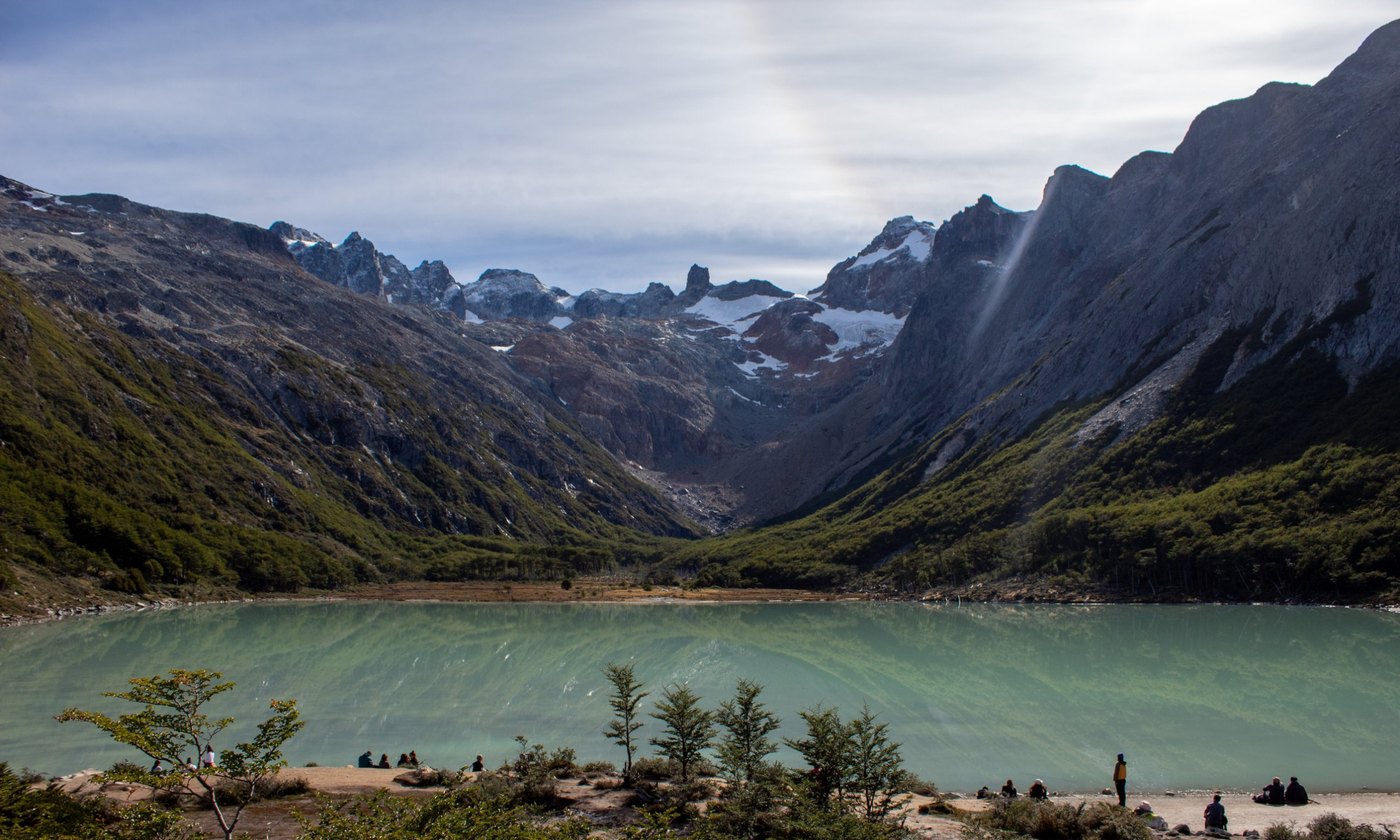
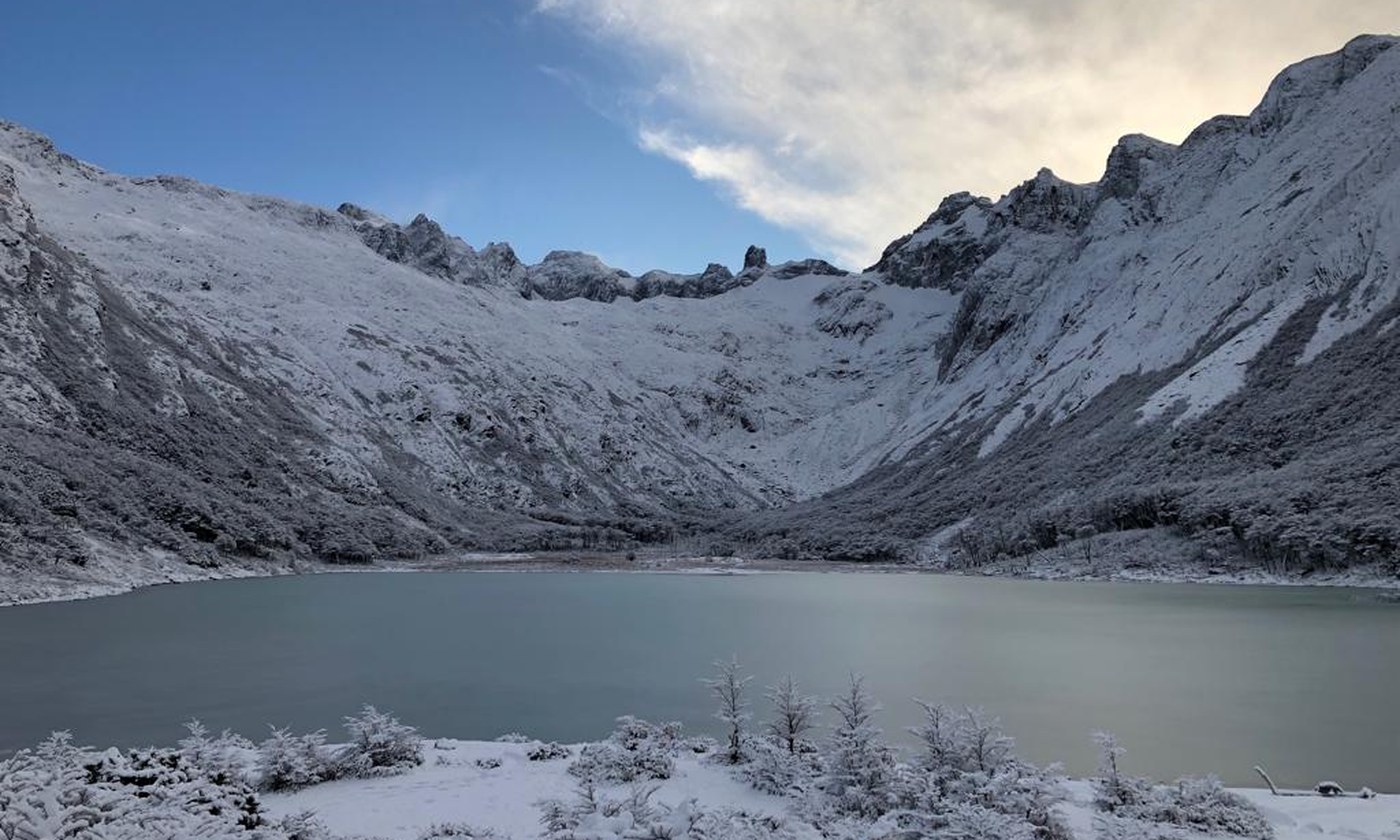
The same Laguna Esmeralda in summer and in winter.
How to read the Ushuaia forecast
This is the practical part, and the one that will help you most if you are coming to do things outdoors.
The forecast on your phone is not enough. The apps that come installed on your phone use a single global model, at a resolution that does not tell the city, a mountain valley and the channel coast apart. In terrain like this, that difference is exactly what matters.
We use Windguru and Windy. They are the two most reliable tools for this area, and the ones the team checks before every departure.
How to read a weather forecast
An example of one day in Ushuaia. Speeds are in knots, the way Windguru and Windy show them.
| Time | 09 | 12 | 15 | 18 | 21 | 00 |
| 1. Wind knots | 8 | 12 | 18 | 24 | 19 | 13 |
| 2. Gusts knots | 14 | 20 | 28 | 35 | 29 | 21 |
| 3. Direction | W | W | SW | SW | W | W |
| 4. Rain mm | 0 | 0.2 | 1.4 | 0.6 | 0 | 0 |
| Temperature °C | 5 | 7 | 9 | 9 | 8 | 6 |
| 5. Freezing level m | 900 | 700 | 500 | 400 | 600 | 800 |
Wind scale, in knots
0 to 10 10 to 15 15 to 20 20 to 30 over 30
1 knot is 1.85 km/h. 20 knots is about 37 km/h. Illustrative chart by Explore Tierra del Fuego: the values are an example, not a real forecast.
What to look at, in this order:
- The wind, before the temperature. Check the speed and, above all, the gusts, which are usually quite a bit stronger than the sustained wind. If the forecast is in knots, multiply by 1.85 to get km/h: 20 knots is about 37 km/h.
- The wind direction. In Ushuaia it comes mostly from the west and southwest.
- Precipitation in millimetres, not just the icon. 1 mm spread over the day is not the same as 10 mm in two hours.
- Cloud cover. If what you want is to see the mountains or take photos, low cloud matters as much as rain.
- The exact spot. In Windy you can move the point on the map to the valley or the peak you are heading to, instead of settling for the city forecast.
- More than one model. Both tools let you compare different weather models. When they agree, the forecast is more reliable. When they do not, it is worth checking again closer to the day.
The freezing level, the figure almost nobody looks at
Among all the information in the forecast there is one number that matters more than the temperature in the mountains: the freezing level. It is the altitude, in metres, at which the temperature reaches zero degrees.
It answers, at a glance, the question that matters: up there, is it going to rain or snow? Above that line precipitation falls as snow; below it, as rain.
An example with the figures from the chart. At 18:00 the freezing level is at 400 metres: in the city those 0.6 mm fall as rain, while in a mountain valley, at 500 or 600 metres, it is already snowing.
There is a simple rule guides use: the temperature drops around 0.6 °C for every 100 metres you climb. If it is 9 °C in Ushuaia, at 800 metres there are about 4 °C left. And that is before adding the wind.
So when the freezing level drops, it is not only what you wear that changes: the state of the trail can change too, with soft snow or ice on the higher stretches.
An example
The forecast says: 7 °C, wind of 30 km/h and rain.
It does not only mean "it is cold and raining". It means that if you are going to stand still at a viewpoint or on the deck of a boat, you will need warm layers and a windproof shell. It means waterproof clothing is not optional. And it means that if you are walking, you will probably be comfortable while you move and feel cold as soon as you stop.
And one local habit: check the forecast the day before, but check it again on the morning of the tour. Things change here.
What if the weather changes on the day of your tour?
It is the question we get most before people book. The short answer is that in Ushuaia almost everything runs anyway.
Tours are not cancelled because of rain or snow. If we waited for perfect days we would hardly work at all, and you would miss much of what you came to see. We go out in rain, we go out in snow and we go out in the cold. That is what the right gear and a guide who knows the terrain are for. What we do adjust is the plan: changing the order of the route, choosing another trail, or waiting out the worst part of the day.
The exception is the boat trips, and the reason is the wind. On the Beagle Channel the decision is not made by the agency or by the boat company: it is made by the Argentine Naval Prefecture, the authority in charge of safety on the water. When conditions justify it, they close the port and nobody sails. From around 25 knots things start to get complicated, though there is no magic number: the state of the sea and the forecast for the following hours also count.
It can almost always be seen coming a day or two in advance, which is exactly what we watch Windguru and Windy for.
Our advice: do the boat trip in the first days of your stay, not on the last one. If they close the port that day and it was your last day in Ushuaia, there is no room left to reschedule.
If it is suspended, we always try to reschedule for another day of your stay. And if there is no way to fit it in, the money is refunded.
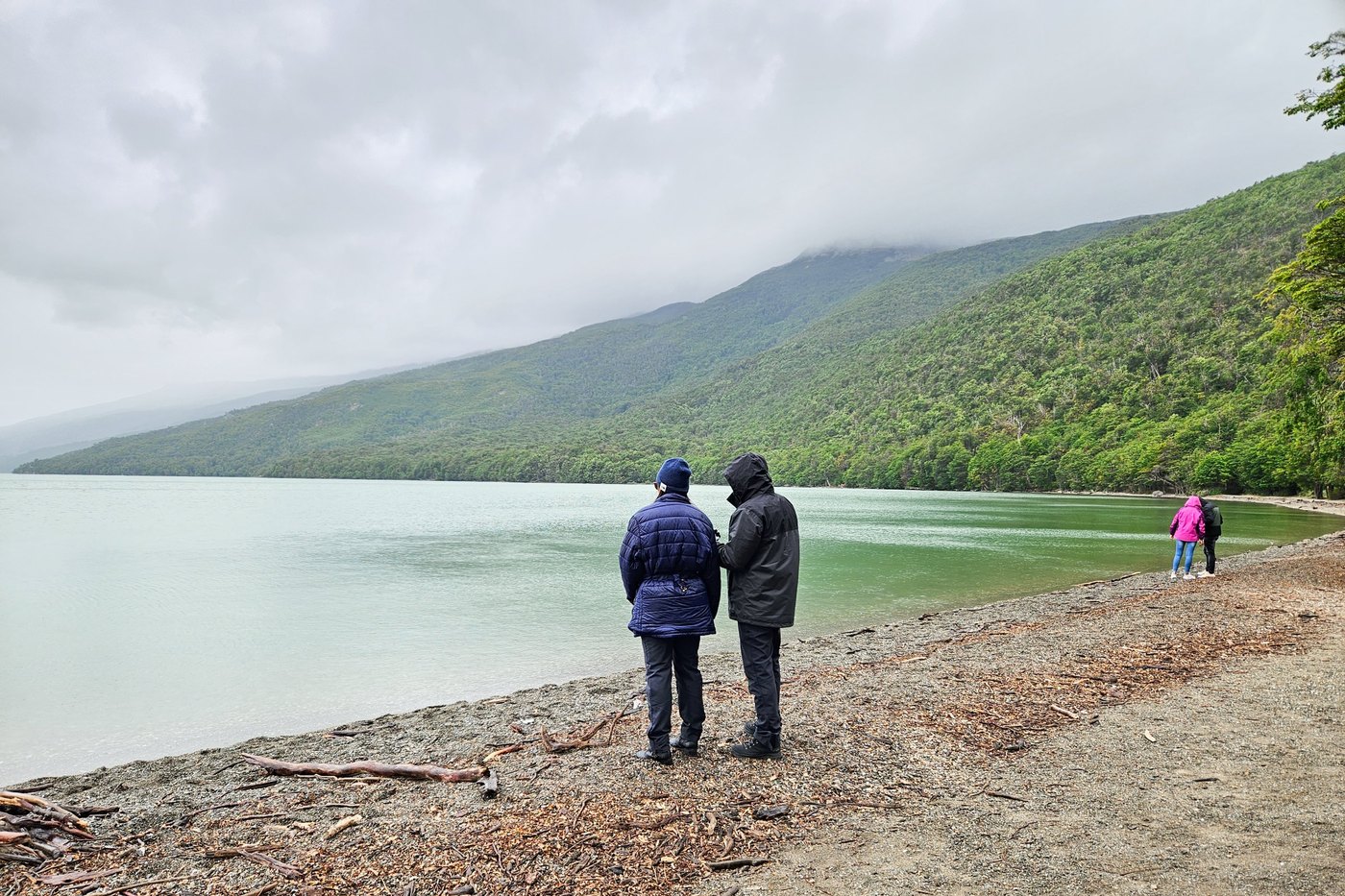
A cloudy day on the shore of Lago Roca. The tour ran anyway.
How should you dress for the weather in Ushuaia?
The first idea to drop is bringing the warmest clothing you own. With a huge down jacket you will overheat in the forest and still be cold at the viewpoint, because you will have no way to adjust.
In Ushuaia you do not need the biggest coat. You need to be able to adapt. That is done with three layers:
- Base layer: next to your skin, its job is to keep you dry. Thermal or synthetic is best. Cotton, once it gets wet from sweat or rain, stays wet and chills you.
- Mid layer: it keeps the heat in. A fleece or similar. This is the one you take off when you start walking and put back on when you stop.
- Outer layer: it protects you from wind and water. A waterproof, windproof jacket. Here it is the most important of the three, because of the wind.
Add proper waterproof footwear, a hat, gloves and a backpack to keep whatever you take off. That backpack is the key to the whole system: without it, the layers are useless.
If you are going trekking, we go into detail in our Laguna Esmeralda guide.
The weather is not an obstacle: it is part of the landscape
There is a different way of looking at all this.
Rain changes the colours of the forest and makes the green more intense. Snow transforms the mountains completely. The wind moves the water of the channel and the clouds over the peaks. And the fog, which hides the mountains for a while, suddenly opens and shows them to you whole.
Those of us who live here know that the same place can look completely different on the same day. That is, to a large extent, why we never get tired of going back to the same places.
In Ushuaia the weather does not only decide what to wear. It is part of the experience of getting to know the End of the World. And if you come prepared, it stops being a problem and becomes what makes every day different.
Frequently asked questions
Does it rain a lot in Ushuaia?
It rains often, but it rains little. 457.8 mm fall per year, less than half of Buenos Aires, spread over about 175 days. It is brief drizzle rather than long downpours: a dry climate with many days of precipitation.
Is it very cold in Ushuaia?
Less than people imagine. In July, the coldest month, the average high is 4.6 °C and the average low 0.2 °C. The ocean moderates temperatures all year round. What does lower the feel-like temperature is the wind.
Can it snow in summer?
Yes, although it is uncommon: January and February record less than one day with snow per month in the city. Higher up it is more frequent, and it can snow at any time of year.
Does it rain and snow on the same day in Ushuaia?
It can happen, above all in autumn and spring. It is also common for it to rain in the city while it snows in the mountains: it depends on the height of the freezing level.
Which is the coldest month?
July, with an average temperature of 2.3 °C.
Which is the rainiest month?
April, with 47 mm. The driest is October, with 28.4 mm. The difference between months is small: there is no rainy season.
Is it windy all year round?
The wind is present all year, averaging about 13 knots, but it is not even: the windiest season is summer, exactly when most visitors arrive. Autumn and winter bring more calm days.
What clothes should you bring to Ushuaia?
Three layers: a thermal base, a mid layer for warmth and a waterproof, windproof jacket. Plus waterproof footwear, a hat, gloves and a backpack to keep whatever you take off.
Does the weather in Ushuaia change a lot during the day?
Yes. You can get sun, rain and wind within a few hours, above all in mountain areas. What does not change as much is the temperature, which stays fairly stable.
Is the Ushuaia forecast reliable?
For the next 24 to 48 hours, reasonably so. Beyond that it is better taken as a trend. We recommend Windguru and Windy over the app on your phone, and checking again on the morning of the tour.
What is the difference between the weather in Ushuaia and in the mountains?
Higher up it is always colder, windier and more likely to rain or snow. The temperature drops around 0.6 °C for every 100 metres of ascent. The city forecast does not describe what you will find on a mountain tour.
Are tours cancelled because of bad weather?
Land tours are not cancelled because of rain or snow. Boat trips can be suspended because of wind, when the Argentine Naval Prefecture closes the port.
What happens if it rains on the day of my tour?
It runs anyway. The guide adapts the route if needed. It is worth coming with waterproof clothing.
What happens if my boat trip is suspended?
We try to reschedule it for another day of your stay. If that is not possible, it is refunded. That is why we recommend not leaving it for the last day.
Keep exploring
Sources: Servicio Meteorológico Nacional, Ushuaia Airport station, 1991-2020 averages. Windfinder, Ushuaia station, 2010-2026 observations.