When you think of penguins in Ushuaia, you probably picture them in summer: nests, chicks, long days, and colonies bustling with life. And that’s true: most arrive in spring and leave when the cold sets in. But there’s an exception that few people know about. In the Beagle Channel, off Ushuaia, one species stays all year round—even in the depths of winter. And that means something wonderful for anyone visiting outside the summer season: yes, you can still go and see them, just when you thought there were none left to spot.
The myth: “Penguins are only around in summer”
To understand why this is so unusual, we first need to look at how penguins live. They are seabirds: they spend most of the year at sea, feeding. In spring, they return to land for the most important events of the year—building their nests, laying eggs, raising their chicks, and replacing their feathers—and when the cold arrives, they head back out to sea.
Many also migrate hundreds or thousands of kilometres, seeking more productive waters where they can spend the winter feeding and rebuilding the strength they will need for the next breeding season.
In Ushuaia, the clearest example is the Magellanic penguin: thousands arrive on Isla Martillo in October, breed during the summer, and head out to sea towards the end of March, migrating north. They don’t return until the following spring.
That life cycle—arriving in spring and leaving in autumn—is shared by almost all the world’s penguins. Almost.
The exception: the gentoo penguin
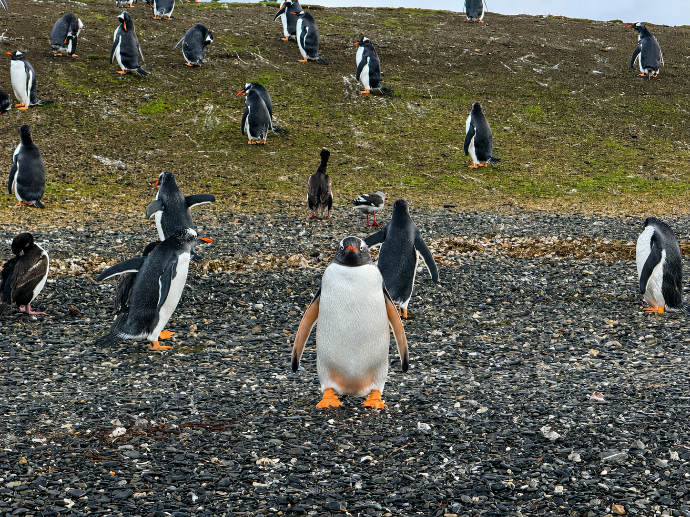
Alongside the Magellanic penguins, on the very same island, lives a much smaller colony: gentoo penguins (Pygoscelis papua), easily recognised by the white stripe across their heads.
And, for a start, they are beautiful penguins: a vivid orange bill, that white band connecting their eyes over the top of the head, and orange feet. They are the world’s third-largest penguin—after the emperor and king penguins—and the fastest underwater: they swim like arrows. Seeing one is a privilege in itself.
The gentoo belongs to a group of cold-water penguins whose close relatives live in Antarctica and on subantarctic islands. But it is the one that ventures furthest north—and for a species like this, Tierra del Fuego is already a frontier, the northern edge of its world.
It is also the biggest homebody of them all. Unlike Magellanic penguins and almost every other penguin, gentoos do not undertake a long winter migration. That doesn’t mean they don’t go to sea—they do, every day, to feed—but they stay close and return. Their lives revolve around the same island.
Key fact: Isla Martillo is home to the only breeding colony of gentoo penguins in continental South America, outside the Falkland Islands (Islas Malvinas). It is just a short boat ride from Ushuaia.

The others migrate. They stay.
Here’s what makes it so interesting. On the same island, two species follow opposite paths. Magellanic penguins head out to sea for around six months, as almost all penguins do. Gentoos stay.
Why? The answer lies in how each species feeds. Gentoos find their food near the coast and on the seabed, in shallow waters very close to the colony. Their trips are short: they head out, feed, and return on the same day. They don’t need to go anywhere else because their food is still there, just around the corner, even in winter.
There’s another factor: the Beagle Channel doesn’t freeze over. Further south, ice can block access to colonies and force penguins to disperse. That doesn’t happen here: the island remains accessible all year round.
They return to shore every afternoon
One of the loveliest things about this colony is that you can watch the gentoos going about their daily routine. They head out early to feed and
And there’s something that still amazes us, even after seeing it so many times: they return at almost the same time, in groups that sometimes number 20 or more, porpoising—leaping out of the water like dolphins—as they approach the island. It’s a breathtaking sight: the kind no photograph can fully capture, and one you never forget.
Key fact: A team from CADIC-CONICET, Ushuaia’s scientific research centre, documented this behaviour using a camera trap that took one photograph every hour for an entire year. They confirmed that gentoos attend the colony throughout the year, making daily trips to sea. What we see from the water is backed by scientific evidence.
So why do they stay?
Ultimately, the reason is simple: they have everything they need right here.
- Food nearby, all year round. They feed on the seabed next to the island, and that food doesn’t disappear in winter.
- A channel that doesn’t freeze over. The colony remains their home throughout all twelve months.
- Migration takes a lot of energy. Staying close to a familiar place saves them energy and reduces risks.
- They start early. They begin pairing up as early as September, so staying close to their nesting site works in their favour.
When is a good time to see them in winter?
The gentoo colony is there throughout the winter. And contrary to what many people imagine, winter on the channel often brings light winds: trips are rarely cancelled, and boats can go out almost every day. Add to that the best part of travelling outside the summer season: far fewer people, a quieter and more intimate experience, and a different quality of light, with long, soft sunsets over the water.
If you love wildlife and are looking for something beyond the usual sights, winter is an ideal time to experience this story for yourself.
Quick questions (FAQ)
Can you see penguins in Ushuaia in winter?
Yes. Gentoo penguins stay in the Beagle Channel all year round, including winter. Magellanic penguins, on the other hand, migrate and return in spring.
How many gentoos are there in the colony?
It’s a small colony—around 50 pairs—but with a remarkable story: it began with a single pair in the early 1990s and has kept growing ever since.
Will I see them up close?
Yes, very close. We head out in a small boat, making this a very different experience from a catamaran trip: gentoos are very curious and come closer. You’ll see them in their natural habitat, without disturbing them, accompanied by guides who know the area and the species’ behaviour.
Is it the same excursion as in summer?
Our trip—with very small groups, departing from Puerto Almanza—runs all year round. In summer, catamaran trips are also available: a less intimate experience, but one that takes you along the entire Beagle Channel. In winter, the more intimate, close-up option remains, with the gentoo colony always there.
Want to experience it for yourself? Join our small-group penguin-watching boat trip, departing from Puerto Almanza.
Book: Penguin Watching by Small Boat
Book: The King Crab Route & Penguin Watching
Written by the Explore Tierra del Fuego team.